
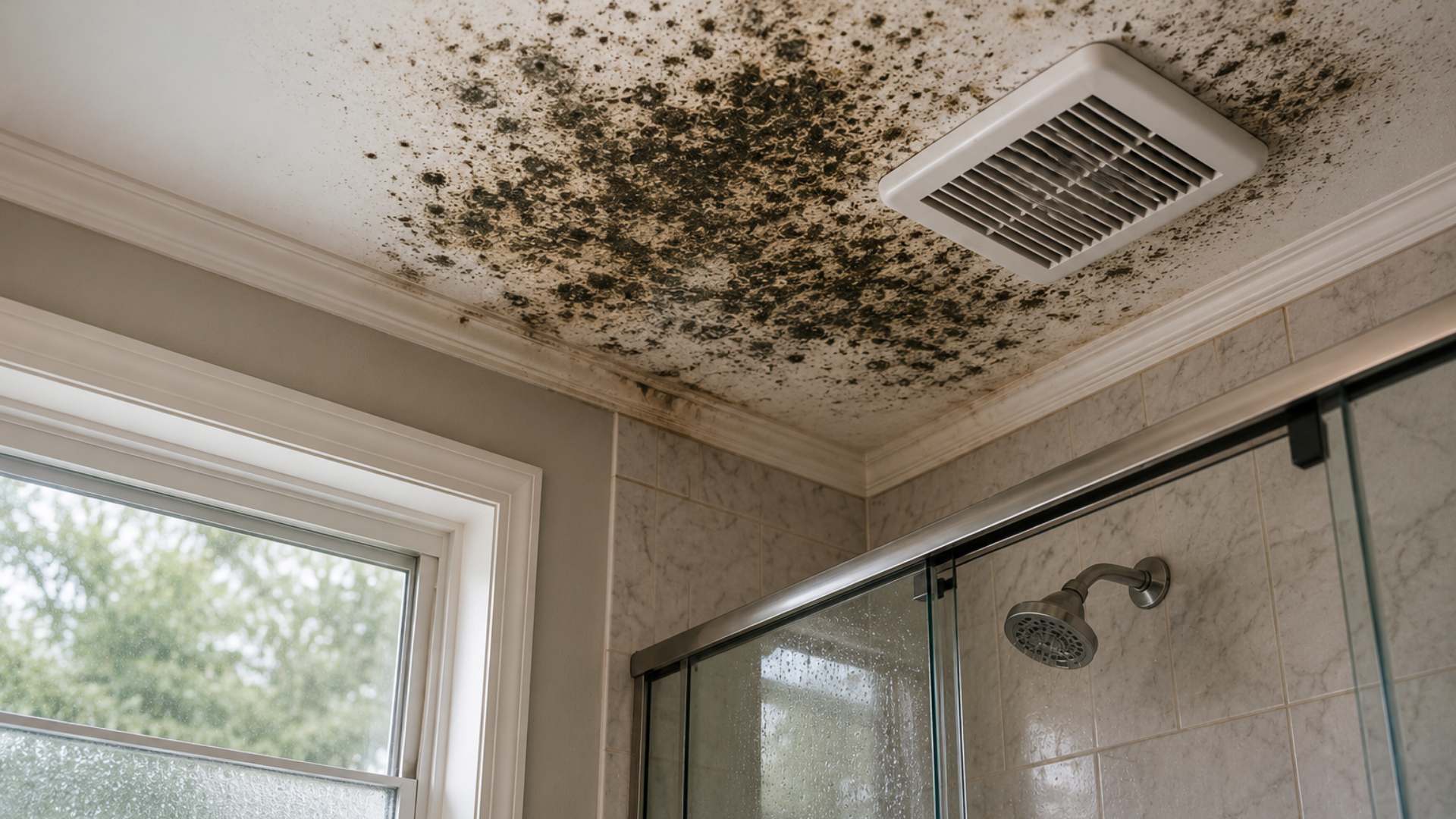
Every August, the same pattern shows up in bathrooms across Dayton, Beavercreek, and Fairborn. Black speckling on the ceiling above the shower. A musty smell that cleaning does not fix. Paint that bubbles near the exhaust fan. Homeowners scrub it away, and by Labor Day it is back.
The reason is simple: August is the most humid stretch of the year in southwest Ohio, with outdoor dew points regularly sitting in the range where indoor air struggles to shed moisture. Your bathroom adds a hot shower’s worth of steam to air that is already saturated, and if that moisture is not mechanically removed, it condenses on the coolest surfaces in the room and feeds mold. This is not a cleaning problem. It is a ventilation problem, and Ohio’s building code has specific things to say about it.
Why August Is the Breaking Point
During cooler months, the air outside is dry enough that even a weak exhaust fan, or a cracked window, can eventually clear shower steam. In August, the outdoor air arriving through leaks and open windows carries nearly as much moisture as the air you are trying to push out. Marginal ventilation that survives the rest of the year fails in late summer. That is why mold in Dayton bathrooms is seasonal: the ventilation was never adequate, but August is when the margin disappears.
Older housing stock makes it worse. Many Beavercreek and Fairborn homes built between the 1960s and 1980s have original builder-grade fans that move far less air than their rating suggests, ducts that run long flexible paths through hot attics, or fans that vent into the attic instead of outdoors, which relocates the mold problem rather than solving it.
What Ohio Code Actually Requires
Under the Residential Code of Ohio, which is based on the International Residential Code, a bathroom must have either an operable window of sufficient size or mechanical ventilation exhausted directly to the outdoors. In practice, for any bathroom with a shower or tub, mechanical ventilation is the standard that works, because an open window in an Ohio August is pulling humid air in, not pushing it out.
The commonly applied standard calls for an intermittent exhaust fan rated at a minimum of 50 CFM, or continuous ventilation at a lower rate. Two details matter as much as the number:
- The duct must terminate outside. Venting into an attic or soffit cavity violates the intent of the code and grows mold on your roof sheathing.
- Rated CFM is not delivered CFM. Long duct runs, tight bends, and crushed flex duct can cut a fan’s real-world performance dramatically. A 50 CFM fan on a bad duct run may move half that.
Sizing the Fan for the Room, Not the Minimum
The minimum keeps you legal. It does not always keep you dry. A practical rule used across the industry is roughly 1 CFM per square foot of bathroom floor area for standard-height rooms, with upgrades for large soaking tubs, separate shower rooms, or bathrooms with high ceilings. Running the fan during the shower and for 20 to 30 minutes afterward matters just as much, which is why humidity-sensing fans and timer switches have become standard in quality bathroom renovations. They remove the human error from the equation.
When Mold Is Telling You Something Bigger
Surface mold on paint is a ventilation symptom. Some signs point past the fan to the structure of the bathroom itself:
- Mold returning within days of cleaning, even with the fan running properly
- Soft or spongy drywall around the tub or shower surround
- Loose tiles, failing grout, or caulk lines that never stay sealed
- A persistent musty smell coming from inside the wall, not the surface
These usually mean moisture has gotten behind the wall assembly, and in bathrooms from the 1970s and 1980s that often reveals standard drywall behind tile where cement board belongs. At that point the fix is not a bigger fan. It is opening the wet assembly, correcting it with modern moisture-rated materials, and rebuilding the ventilation path correctly at the same time.
Frequently Asked Questions
Why does my bathroom grow mold in summer but not winter?
Direct answer: Summer humidity in the Dayton area overwhelms marginal bathroom ventilation. In August, outdoor air is nearly as moist as shower steam, so weak fans and open windows can no longer clear moisture before it condenses and feeds mold.
Key details: Mold needs sustained surface moisture. In winter, dry outdoor air helps bathrooms dry out between showers. In late summer, that natural drying stops, exposing undersized fans, attic-vented ducts, and short fan run times.
Expert insight: Seasonal mold is the clearest sign the problem is ventilation capacity, not cleaning habits. If it comes back every August, the system is undersized for our climate.
Next step: Check where your fan duct terminates and how long the fan runs after showers before assuming you need wall repairs.
What does Ohio code require for bathroom ventilation?
Direct answer: The Residential Code of Ohio requires bathrooms to have either an adequate operable window or mechanical exhaust ducted directly outdoors, with intermittent fans commonly required to deliver at least 50 CFM.
Key details: The exhaust must terminate outside the building envelope, not in an attic or soffit. Local jurisdictions in Greene and Montgomery counties enforce these requirements during permitted bathroom remodels.
Expert insight: Most code failures we find in older Beavercreek and Fairborn bathrooms are duct problems, not fan problems. The fan is fine; the duct dumps moisture into the attic.
Next step: If your bathroom has never been updated, have the duct path verified before mold season, since it is a quick check with a big payoff.
What size exhaust fan do I need for my bathroom?
Direct answer: Use roughly 1 CFM per square foot of floor area as a working guideline, with 50 CFM as the practical minimum for any full bathroom.
Key details: Large tubs, enclosed shower rooms, and ceilings above eight feet call for additional capacity. Duct length and bends reduce delivered airflow, so fan selection should account for the actual duct run.
Expert insight: In our renovations we default to quiet, humidity-sensing fans sized above minimum, because a fan nobody turns on, or turns off too early, protects nothing.
Next step: Measure your bathroom, check your current fan’s rating, and compare. If the fan is original to the house, it is almost certainly undersized.
When is bathroom mold a sign I need a renovation instead of a cleaning?
Direct answer: When mold returns quickly despite proper ventilation, or when walls feel soft, tiles loosen, or musty odors come from inside the wall, moisture has entered the wall assembly and the bathroom needs corrective renovation.
Key details: Many area bathrooms built before the 1990s have moisture-vulnerable materials behind their tile. Once water reaches them, surface treatments cannot reverse the damage.
Expert insight: The renovations with the best long-term results fix ventilation, wall assembly, and waterproofing together, since solving only one leaves the failure cycle in place.
Next step: If you are seeing structural symptoms, get a professional evaluation before winter, when closed-up houses make hidden moisture worse.
Dream Big Contracting LLC is a veteran-owned remodeling company serving the Dayton area. If your bathroom’s mold problem points to something behind the walls, learn more about bathroom renovation in Dayton.